
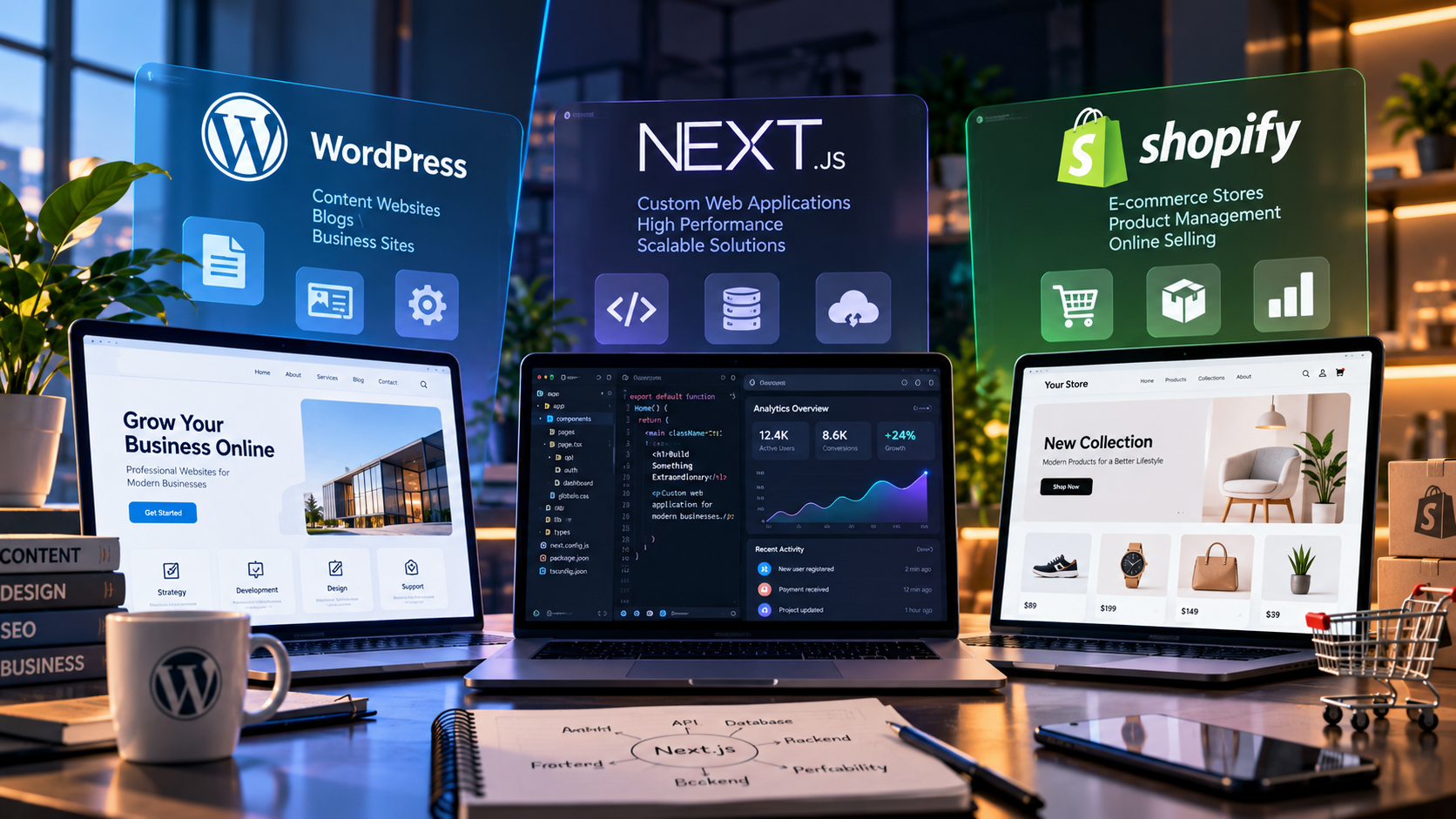
WordPress vs Next.js vs Shopify: Which Platform Is Right for Your Business?
Introduction
Choosing the right technology is one of the most important decisions when building a website.
Some businesses need a professional website to showcase their services. Others want to sell products online, while some need advanced features such as customer dashboards, booking systems, or custom business applications.
With platforms such as WordPress, Next.js, and Shopify available, choosing the right option can feel confusing.
Each platform serves different purposes. The best choice depends on your business goals, required features, budget, and plans for future growth.
In this guide, we will compare WordPress, Next.js, and Shopify to help you make an informed decision.
1. What Is WordPress?
WordPress is a popular content management system (CMS) that allows businesses to build and manage websites without developing every feature from scratch.
It is commonly used for business websites, blogs, portfolios, and content-focused websites. With plugins and themes, businesses can extend its functionality for many different requirements.
Benefits of WordPress
- Easy content management.
- A large ecosystem of themes and plugins.
- Suitable for blogs and SEO-focused websites.
- Flexible design and customization options.
- Multiple hosting options.
Limitations of WordPress
- Too many plugins can increase complexity.
- Poorly maintained themes or plugins can create security risks.
- Advanced custom functionality may require development expertise.
- Performance depends on hosting, configuration, and implementation quality.
Best for: Business websites, blogs, service websites, and content-driven platforms.
2. What Is Next.js?
Next.js is a web development framework built on React. Developers use it to create custom websites and web applications with flexible rendering, routing, and data-fetching capabilities.
Unlike a traditional CMS, Next.js generally requires developers to build or integrate the content management and administrative tools the project needs.
It is suitable for businesses that require custom functionality, interactive interfaces, and more control over their application architecture.
Benefits of Next.js
- High flexibility for custom development.
- Supports server rendering and static generation.
- Can deliver excellent performance when implemented well.
- Integrates with APIs, databases, and external services.
- Suitable for complex web applications and SaaS products.
Limitations of Next.js
- Requires development expertise.
- Initial development may cost more than a simple website setup.
- Hosting, caching, and rendering need appropriate configuration.
- Content management may require a separate CMS or custom admin panel.
Best for: Custom web applications, SaaS platforms, complex business websites, and interactive digital products.
3. What Is Shopify?
Shopify is a hosted e-commerce platform designed to help businesses sell products online.
It provides tools for managing products, inventory, orders, payments, and storefronts. Businesses can customize their stores through themes, apps, and development when needed.
Because many essential commerce features are already available, Shopify can reduce the amount of custom infrastructure a business needs to build and maintain.
Benefits of Shopify
- Built-in product and order management.
- E-commerce-focused features.
- Theme-based storefront customization.
- App integrations for additional functionality.
- Hosted infrastructure and platform maintenance.
Limitations of Shopify
- Subscription and app costs can accumulate.
- Some customizations are limited by platform capabilities.
- Businesses depend on Shopify’s ecosystem and platform rules.
- Advanced requirements may need custom development or integrations.
Best for: Online stores, direct-to-consumer brands, and businesses selling products online.
WordPress vs Next.js vs Shopify: Comparison
| Feature | WordPress | Next.js | Shopify |
|---|---|---|---|
| Primary purpose | Content websites | Custom websites and apps | E-commerce |
| Ease of management | Generally easy | Depends on the tools built around it | Generally easy for store operations |
| Customization | Themes, plugins, custom code | Extensive developer control | Themes, apps, custom code |
| Content management | Built in | Usually needs a CMS or custom solution | Built in for store content |
| E-commerce | Through plugins or integrations | Through custom development or integrations | Core capability |
| Technical expertise | Low to high | Usually high | Low to high |
| Ongoing costs | Hosting, maintenance, plugins | Hosting, development, maintenance | Subscription, apps, and transaction-related costs where applicable |
No platform is automatically the fastest, cheapest, or best for every business. The result depends on the project’s requirements and implementation.
4. Which Platform Should You Choose?
Choose WordPress If…
You need a professional business website, a company blog, service pages, or a content-driven website that your team can update easily.
For example, an IT company publishing blogs, showcasing projects, and generating enquiries may find WordPress a practical choice.
Choose Next.js If…
You need custom features, complex user interactions, dashboards, SaaS functionality, or a web application designed around specific business workflows.
For example, a startup building a subscription-based software product may benefit from Next.js when it fits the team’s technical requirements.
Choose Shopify If…
Your primary goal is to sell physical or digital products through an online store.
For example, a fashion brand or cosmetics business may prefer Shopify for product listings, inventory management, order processing, and storefront operations.
5. What About SEO and Website Performance?
All three platforms can support strong search visibility when implemented correctly.
For WordPress, focus on content quality, technical configuration, suitable plugins, and performance.
For Next.js, ensure pages are rendered appropriately for their content, important pages are crawlable, and metadata and structured data are implemented correctly where relevant.
For Shopify, optimize product descriptions, collection pages, images, navigation, and technical SEO settings.
In every case, website speed also depends on image sizes, scripts, hosting or infrastructure, and the overall implementation.
Simply choosing a particular technology does not guarantee better Google rankings.
6. Think Beyond the Initial Development Cost
The cheapest initial build is not always the most economical long-term option.
When evaluating a platform, consider:
- Initial design and development costs.
- Hosting and subscription expenses.
- Third-party plugins and apps.
- Security updates and ongoing maintenance.
- Future feature development.
- Integration requirements.
- Your team’s ability to manage the website.
A simple website may not need a complex custom framework. Similarly, a sophisticated SaaS product may become difficult to manage if it is built around tools that do not fit its requirements.
The objective is to choose technology that supports your business without introducing unnecessary complexity.
7. Can You Combine These Technologies?
Yes. Businesses do not always need to choose just one platform for everything.
For example, a company could use WordPress to manage marketing pages and blog content, Next.js to power a custom web application, and Shopify to handle its online store.
This approach can work when each platform has a clearly defined role, but it also introduces integration and maintenance considerations.
Combining technologies should solve a real requirement rather than make the architecture more complicated without sufficient benefit.
How Growth Metaverse Can Help
At Growth Metaverse Pvt Ltd, we understand that every business has different digital requirements.
Our approach is to understand your goals, users, required features, and long-term plans before selecting an appropriate technology.
Depending on the project, we can help businesses with:
- Business website design and development.
- WordPress websites and content management.
- Shopify stores and e-commerce development.
- Custom web applications using modern frameworks.
- API integrations and business software.
- Website optimization and ongoing improvements.
The right technology should make your business easier to operate, your customers’ experience better, and future development more manageable.
Conclusion
WordPress, Next.js, and Shopify are all useful technologies, but they solve different problems.
WordPress is a strong option for content-driven websites. Next.js offers flexibility for custom web applications and advanced digital experiences. Shopify is designed around online selling and e-commerce operations.
Before choosing a platform, identify what your business needs today and what it may need as it grows.
The best website technology is not the most complicated one. It is the one that fits your business goals.
Need help choosing the right platform for your next project? Contact Growth Metaverse Pvt Ltd to discuss your website or web application requirements.